Physical Address
304 North Cardinal St.
Dorchester Center, MA 02124
Physical Address
304 North Cardinal St.
Dorchester Center, MA 02124
Virginia Woolf's Night & Day review: Is Haley Bennett's 2026 period romance worth watching? See our spoiler-free verdict, story, cast, ratings and where to watch.
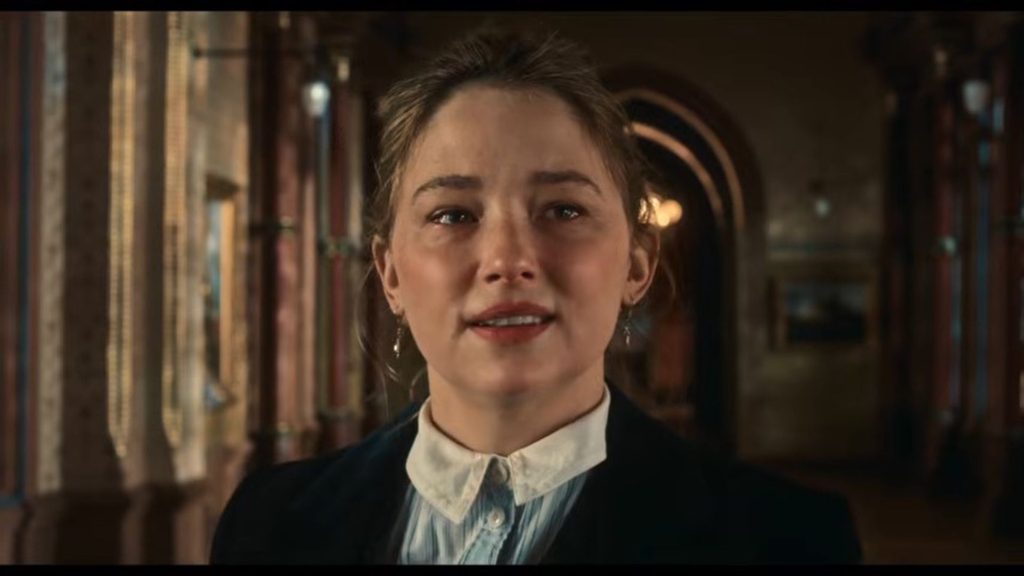
Virginia Woolf’s Night & Day takes one of Virginia Woolf’s early novels and gives it a surprisingly modern makeover. Instead of treating the material like a stiff literary period piece, director Tina Gharavi turns it into a lively romantic comedy about ambition, independence, love and a woman trying to decide what kind of life she actually wants.
Led by Haley Bennett, with Lily Allen, Elyas M’Barek, Jack Whitehall, Jennifer Saunders and Timothy Spall rounding out the cast, the 2026 film mixes Edwardian romance with women’s rights, science, social expectations and a distinctly contemporary sense of humor.
But is Virginia Woolf’s Night & Day actually worth watching?
Here’s our spoiler-free review, including the story, cast, release date, ratings, where to watch and our final verdict.
| Movie | Virginia Woolf’s Night & Day |
|---|---|
| Release Date | September 4, 2026 (U.S. limited theatrical release) |
| UK Release | June 19, 2026 |
| Germany Release | July 9, 2026 |
| Director | Tina Gharavi |
| Screenplay | Justine Waddell |
| Based On | Night and Day by Virginia Woolf |
| Cast | Haley Bennett, Lily Allen, Elyas M’Barek, Jack Whitehall, Jennifer Saunders, Timothy Spall |
| Genre | Drama, Romance, Comedy |
| Runtime | 95 minutes |
| Country | United Kingdom / Germany / United States |
| Language | English |
| Distributor | Quiver Distribution |
The film premiered at SXSW London on June 1, 2026, before its theatrical rollout.
Set in London in 1910, the movie follows Katharine Hilbery (Haley Bennett), an intelligent young woman born into a respected literary family.
Katharine is not particularly interested in following the conventional path expected of her. While society expects women of her position to think about marriage, family and maintaining appearances, Katharine has another obsession: astronomy.
She wants to study the stars and build an intellectual life of her own.
That ambition immediately puts her at odds with the world around her.
Katharine’s personal life becomes increasingly complicated as she encounters people with very different ideas about love, marriage, politics and independence. Among them are Ralph Denham (Elyas M’Barek), a thoughtful and politically minded editor, and Mary Datchet (Lily Allen), a strong-willed woman involved in the suffragette movement.
The central question is simple:
Can Katharine build the life she wants without allowing society — or romance — to decide it for her?
That’s where Virginia Woolf’s Night & Day gets its energy.
Rather than turning the story into a straightforward period romance, the movie uses Katharine’s struggle for independence to explore the changing role of women in Edwardian society.
And don’t worry — this review won’t spoil the ending or reveal the major developments.
The biggest surprise about Virginia Woolf’s Night & Day is how contemporary it feels.
This could easily have been another beautifully dressed literary adaptation where everyone speaks politely in enormous rooms while discussing marriage for two hours.
It isn’t.
Tina Gharavi gives the movie considerably more personality.
The film is colorful, playful and occasionally eccentric. It embraces the humor in Woolf’s material rather than treating the author as someone whose work must always be approached with academic seriousness.
That decision works.
The movie understands that a story about a woman refusing to accept the life society has planned for her can still feel relevant more than a century later.
Haley Bennett carries much of the film as Katharine.
The character could have easily become frustrating because Katharine spends so much time wrestling with what she actually wants. Bennett instead gives her an appealing mixture of intelligence, uncertainty and stubbornness.
Katharine isn’t presented as a perfect feminist hero.
She’s complicated.
She can be romantic while resisting romance. She wants independence but doesn’t always know exactly what independence looks like. She wants to understand the world while simultaneously trying to understand herself.
That makes her considerably more interesting than the typical period-drama protagonist.
Bennett also gives the movie enough emotional weight to prevent its more playful moments from becoming too lightweight.
Lily Allen’s Mary Datchet is one of the film’s most interesting supporting characters.
Mary represents a very different kind of independence from Katharine. Her involvement with the suffragette movement gives the film a stronger political dimension and provides Katharine with another perspective on what women can demand from life.
Allen brings humor and confidence to the role.
Her scenes also help broaden the film beyond the familiar “woman choosing between two men” setup.
That’s important because Night & Day is ultimately more interested in women choosing their own futures than simply choosing romantic partners.
Elyas M’Barek plays Ralph Denham, adding another layer to Katharine’s complicated relationship with romance and independence.
The movie doesn’t simply treat Ralph as the obvious answer to Katharine’s problems.
Instead, the relationship becomes part of a larger question about whether love and personal ambition have to compete with each other.
That gives the romantic elements more substance than you might expect from the movie’s lighter tone.
Jack Whitehall plays William Rodney, and his performance is one of the ways the movie leans into comedy.
Whitehall brings his familiar comic timing to the period setting, helping prevent the film from becoming overly solemn.
The humor won’t work for everyone, particularly if you’re expecting a traditional, serious Virginia Woolf adaptation.
But for viewers willing to accept the movie’s deliberately modern approach, it adds a lot of charm.
The strongest element is Katharine’s desire to create a life beyond the expectations placed upon her.
The movie understands that this conflict remains recognizable even though the story is set in 1910.
Haley Bennett provides the emotional center, while Lily Allen, Elyas M’Barek, Jack Whitehall, Jennifer Saunders and Timothy Spall give the ensemble plenty of personality.
The Edwardian London setting is gorgeous without making the film feel museum-like.
The period design, costumes and locations create a romantic backdrop, while the film’s more imaginative visual touches keep it from becoming visually predictable.
This may be one of the biggest reasons the movie works.
Virginia Woolf’s Night & Day isn’t afraid to be funny.
That makes the adaptation feel less like a homework assignment for literature students and more like an accessible romantic comedy with literary roots.
The film’s biggest strength can also become its biggest weakness.
Its modern tone won’t appeal to everyone.
Some viewers may find the movie too whimsical or uneven, especially if they want a more faithful and restrained adaptation of Woolf’s novel.
The story also has a lot of ideas competing for attention: romance, feminism, science, suffrage, class, family expectations and changing social attitudes.
At times, the film can feel like it is trying to juggle all of them at once.
Some of the emotional beats consequently don’t land as strongly as they could.
Still, the movie is only 95 minutes, so it moves quickly rather than becoming an exhausting period epic.
Yes — and that’s one of the more unusual things about it.
The movie deliberately challenges the idea that Virginia Woolf adaptations need to be relentlessly serious.
There is romance, social commentary and drama, but there is also plenty of playful humor.
The result is closer to a literary romantic comedy than a conventional prestige period drama.
If you’re expecting something dark and extremely faithful to Woolf’s original tone, this may surprise you.
If you’re looking for a lighter adaptation with contemporary energy, that’s a good thing.
This isn’t a completely faithful recreation of Woolf’s novel.
The filmmakers make significant choices to emphasize Katharine’s interest in astronomy and her struggle for intellectual independence.
That actually gives the film a clearer cinematic identity.
The astronomy element becomes a useful metaphor for Katharine herself: she wants to look beyond the world immediately in front of her.
The adaptation also places greater emphasis on contemporary ideas about women’s careers and independence, making the story easier for a modern audience to connect with.
For Woolf purists, that may be controversial.
For everyone else, it makes the film considerably more accessible.
At the time of writing, the movie has received a 78% Tomatometer score on Rotten Tomatoes, based on 23 critics.
The current audience/IMDb score is around the 5.9–6.0/10 range, depending on the platform and when the rating is checked.
The critical response suggests that the film’s performances, visual presentation and fresh approach to Woolf are its strongest qualities, although its unconventional tone and adaptation choices may divide audiences.
Virginia Woolf’s Night & Day is currently a theatrical release in the United States, with its U.S. limited theatrical opening on September 4, 2026. Rotten Tomatoes currently lists it as playing in theaters.
The movie previously opened theatrically in the UK on June 19, 2026, followed by releases in other territories including Germany.
Yes, but viewers will need to wait for its streaming release.
According to current listings, Kanopy is scheduled to add the movie on December 15, 2026.
For now, the safest option is to check local theater listings because availability varies by country and city.
Yes — especially if you like smart period romances that aren’t afraid to play with the formula.
This isn’t the kind of movie you watch purely for a complicated plot.
You watch it for the characters, performances, atmosphere and the central question of what happens when someone refuses to live according to the rules handed to them.
Haley Bennett gives the film its emotional center, Lily Allen brings energy to the political side of the story, and the supporting cast keeps the movie lively.
It isn’t perfect.
The tone occasionally feels uneven, and viewers looking for a traditional Virginia Woolf adaptation may find some of the creative choices too modern.
But the movie is short, visually attractive, funny and surprisingly accessible.
And perhaps most importantly, it gives Night and Day a reason to exist as a film rather than simply attempting to reproduce the novel on screen.
Virginia Woolf’s Night & Day is a charming, stylish and surprisingly modern period romance that works best when it stops worrying about being a “Virginia Woolf adaptation” and simply becomes its own movie.
It has enough romance for genre fans, enough comedy to keep things moving and enough social commentary to give the story something to chew on.
The biggest reason to watch it is Haley Bennett, who gives Katharine the intelligence and vulnerability the story needs.
If you’re looking for a serious, traditional literary adaptation, this probably isn’t the version you’re expecting.
But if you want a fun, feminist and visually gorgeous period romance with a modern personality, Virginia Woolf’s Night & Day is absolutely worth a look.
Worth watching? Yes.
Best for: Period romance fans, Virginia Woolf readers, literary adaptations, feminist dramas and viewers who enjoy unconventional romantic comedies.
The film follows Katharine Hilbery, an ambitious young woman in 1910 London who wants to pursue astronomy rather than simply accept society’s expectations surrounding marriage and domestic life.
Yes. The movie is based on Virginia Woolf’s novel Night and Day, with Justine Waddell adapting the story for the screen.
The cast includes Haley Bennett as Katharine Hilbery, Elyas M’Barek as Ralph Denham, Lily Allen as Mary Datchet, Jack Whitehall as William Rodney, Jennifer Saunders and Timothy Spall.
The movie was directed by Tina Gharavi, with a screenplay by Justine Waddell.
The film premiered at SXSW London on June 1, 2026, opened in UK cinemas on June 19, and received its U.S. limited theatrical release on September 4, 2026.
The movie has a runtime of 95 minutes.
The film is currently playing theatrically in the United States. A Kanopy streaming release is currently listed for December 15, 2026.
Yes, particularly if you enjoy period romance, literary adaptations, feminist themes and character-driven stories. Its unconventional modern tone may not work for everyone, but the performances and visual presentation make it an appealing watch.
Yes. This review explains the movie’s premise, characters and themes without revealing the ending or major story twists.